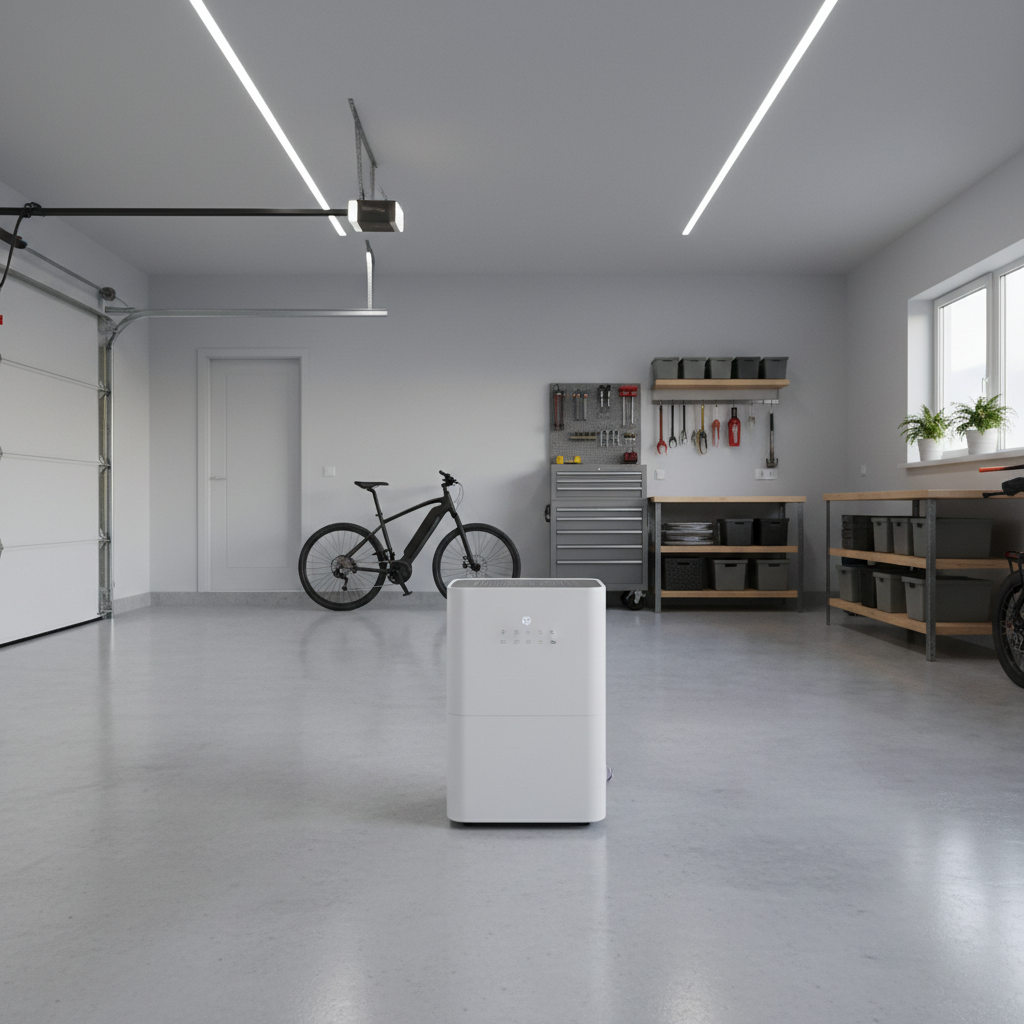
Excess moisture in a garage can cause rust, mold, wood rot, and poor air quality. If you’re dealing with condensation on tools, musty odors, or damp walls, a dehumidifier is one of the most effective solutions. But choosing the wrong size means the unit either overworks itself or fails to make a meaningful difference.
Understanding how dehumidifier sizing works is straightforward once you know the key variables. If you’re also looking for specific product recommendations, check out this guide to the best garage dehumidifiers to find options suited to different garage sizes and climates.
Quick Answer
For most single-car garages (around 250 to 400 sq ft), a 30-pint dehumidifier is sufficient. A two-car garage (400 to 800 sq ft) typically needs a 50-pint unit. Larger or heavily damp garages may require a 70-pint model. Always size up if your garage has poor ventilation, frequent flooding, or is located in a humid climate.
Key Takeaways
- Dehumidifier capacity is measured in pints of moisture removed per day
- Garage size and humidity level are the two primary sizing factors
- Most residential garages need a 30 to 70-pint unit
- Poor ventilation, concrete floors, and climate all increase moisture load
- Undersizing a dehumidifier leads to continuous runtime and premature wear
- Operating temperature matters — many standard units stop working efficiently below 65°F
How Dehumidifier Sizing Works
What Does Pint Capacity Mean?
Dehumidifier capacity refers to how many pints of water the unit can extract from the air in a 24-hour period. A 30-pint dehumidifier removes up to 30 pints of moisture daily under standard test conditions. Higher pint ratings handle larger spaces or more severe moisture problems.
It is important to note that manufacturers test units under specific lab conditions (typically 80°F and 60% relative humidity). Real-world performance in a cooler, larger, or more humid garage may differ.
Why Garages Have Unique Moisture Challenges
Garages present moisture challenges that living spaces typically do not. Concrete floors and walls absorb and release moisture, vehicles bring in rain and snow, and most garages have minimal insulation and ventilation. These factors combine to create a persistently damp environment that demands a properly sized unit.
Dehumidifier Size by Garage Square Footage
Use this table as a general starting point. Adjust upward if your garage is heavily damp or poorly ventilated.
| Garage Size | Condition | Recommended Capacity |
|---|---|---|
| Up to 400 sq ft | Moderately damp | 30 pints |
| Up to 400 sq ft | Very damp or wet | 40 to 50 pints |
| 400 to 800 sq ft | Moderately damp | 50 pints |
| 400 to 800 sq ft | Very damp or wet | 60 to 70 pints |
| 800 to 1,200 sq ft | Any condition | 70 pints or commercial unit |
What Counts as “Very Damp” vs. “Moderately Damp”?
- Moderately damp: The space feels humid, there may be a slight musty smell, but no visible moisture on surfaces
- Very damp: Walls or floors feel wet, condensation is visible on surfaces, or mold spots are present
- Wet: Standing water has occurred, flooding is common, or the garage is partially below grade
Factors That Affect What Size You Need
Climate and Region
Garages in the Southeast, Gulf Coast, and Pacific Northwest experience significantly higher ambient humidity than those in arid regions like the Southwest. If you live in a high-humidity climate, size up by at least one capacity tier regardless of square footage.
Ventilation and Insulation
A well-insulated, sealed garage retains moisture more than one with gaps and airflow. Conversely, a garage with no insulation in a cold climate may see condensation form when warm air meets cold surfaces. Either way, poor ventilation increases the effective moisture load the dehumidifier must handle.
Ceiling Height
Standard sizing charts assume 8-foot ceilings. If your garage has vaulted ceilings, a loft, or extra vertical space, calculate the cubic footage rather than just the floor area. More air volume means more potential moisture.
Attached vs. Detached Garages
Attached garages may benefit from some conditioned air from the home, slightly reducing humidity. Detached garages are fully exposed to outdoor conditions and typically require more dehumidification capacity.
Operating Temperature Considerations
Most residential dehumidifiers are designed to operate between 65°F and 90°F. In colder garages, standard refrigerant-based units may ice up and shut down. If your garage drops below 60°F in winter, look for a unit with an auto-defrost function or consider a desiccant dehumidifier, which works effectively at lower temperatures.
Understanding how electricity consumption works can also help you estimate the ongoing operating cost of running a dehumidifier year-round in an unheated space.
Common Sizing Mistakes to Avoid
- Undersizing: The unit runs constantly, wears out faster, and never reaches target humidity
- Oversizing: Less of a problem, but a very large unit in a small space may short-cycle and reduce efficiency
- Ignoring moisture sources: If water is actively entering through cracks or drainage issues, a dehumidifier alone will not solve the problem
- Forgetting drainage: Larger units fill collection tanks quickly — continuous drain capability is important for high-capacity models
Conclusion
Choosing the right size dehumidifier for your garage comes down to square footage, humidity severity, climate, and how the space is used. For most home or two-car garage under normal conditions. When in doubt, size up rather than down — a slightly oversized unit will reach your target humidity faster and cycle off, while an undersized one will struggle continuously.
FAQs
Is a 30-pint dehumidifier enough for a two-car garage?
A 30-pint unit may be sufficient for a small two-car garage in a dry climate with moderate humidity. However, most two-car garages benefit from a 50-pint model, especially in humid regions or during summer months.
Should I run a dehumidifier in my garage in winter?
Yes, if your garage experiences condensation or moisture issues in winter. Make sure the unit is rated for low-temperature operation, as standard models may not function efficiently below 65°F.
What humidity level should I maintain in a garage?
The ideal relative humidity for a garage is between 45% and 55%. Keeping humidity below 60% prevents mold growth and reduces corrosion on metal tools and equipment.
How long does it take a dehumidifier to dry out a garage?
In a moderately damp garage, a properly sized dehumidifier can reach target humidity levels within 24 to 48 hours of initial use. Heavily saturated spaces may take several days.
Do I need a special dehumidifier for a garage?
Not necessarily, but garages benefit from units with auto-defrost, continuous drain options, and durable construction since conditions are harsher than in living spaces. Standard home dehumidifiers can work but may wear faster in a garage environment.