
For an open patio where warmth is the priority, start with a mushroom-style propane heater such as the EAST OAK 50,000 BTU cone-table model or Amazon Basics 46,000 BTU heater. If a visible flame matters more, the Hiland HLDS01-CGTHG glass-tube heater is a different kind of purchase. Choose the layout and safe clearances first, then compare heat output and features.
Affiliate disclosure: As an Amazon Associate, we earn from qualifying purchases. Product listings and specifications were checked on 4 November 2026. Prices, sellers and availability can change.
Outdoor use only: these propane patio heaters are not suitable for homes, garages, tents or enclosed sunrooms. An open door or a carbon monoxide alarm does not turn an outdoor appliance into an indoor heater. Read the exact model’s manual before deciding whether any roofed outdoor location is permitted.
This guide compares four currently listed heaters by model, practical use and limitations. Recommendations are based on manufacturer documentation and live Amazon product data, rather than hands-on testing. The shortlist focuses on freestanding patio heaters with enclosed tank compartments. Exposed tank-top utility heaters serve a different purpose.
Best outdoor propane patio heaters compared
| Heater / exact listing | Best fit | Listed maximum output | What to check |
|---|---|---|---|
| EAST OAK UR50BK2 cone-table heater | Open seating areas and useful table surface | 50,000 BTU/h | Finish, ballast kit and supplied accessories |
| Amazon Basics 61826, Havana Bronze | Simple freestanding patio heat | 46,000 BTU/h | 91.3-inch height and overhead clearance |
| Hiland HLDS01-WCBT listing | Adjustable table and tank access door | 48,000 BTU/h on Amazon | Match carton/manual because related CBT listings vary |
| Hiland HLDS01-CGTHG glass tube | Visible flame and decorative focal point | 40,000 BTU/h on Amazon; manufacturer versions vary | Verify rating plate, finish and exact revision |
On a phone, swipe the comparison sideways to view all columns.
1. EAST OAK 50,000 BTU cone-table heater: best feature mix
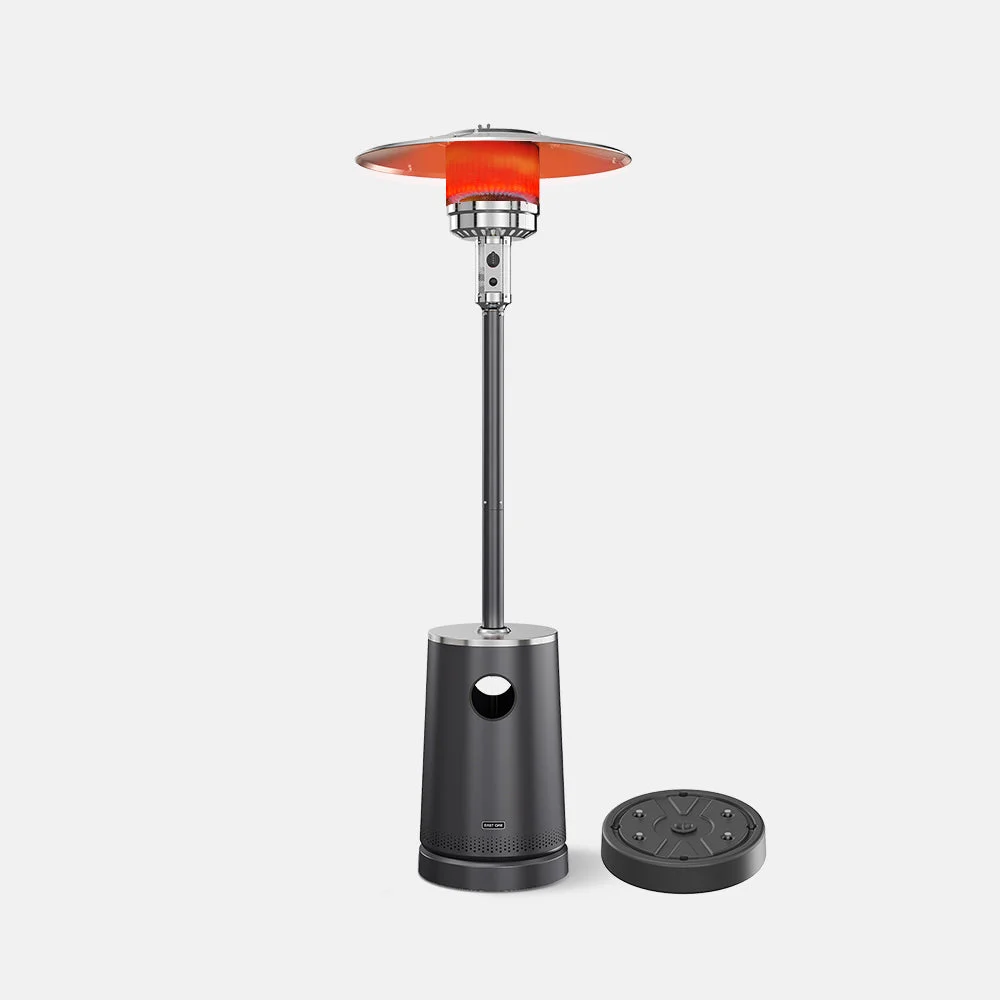
EAST OAK’s 50,000 BTU cone-table design combines a conventional overhead reflector with a table on top of the propane compartment. The linked Amazon listing identifies UR50BK2 and describes a double-layer 304 stainless steel burner mesh, wheels, adjustable heat and a ballast system. The manufacturer specifies outdoor-only operation with a 20-pound propane cylinder, sold separately.
The practical appeal is the table and access opening: you have a place for small items and a way to reach the cylinder valve without lifting the entire tank cover. Fill and secure the supplied ballast exactly as instructed. Ballast improves stability but is not permission to run a tall heater during strong winds.
Treat the advertised heating diameter as an ideal-condition claim rather than a promise of uniform comfort. EAST OAK’s page uses inconsistent radius and diameter language, so we do not convert it into a guaranteed coverage area. Wind, air temperature and seating position will affect how warm guests feel.
- Best for: an open, level patio with room for a freestanding reflector heater.
- Main benefit: a useful table combined with a high listed maximum input.
- Trade-off: a tall appliance and broad reflector need storage space and substantial clearance.
- Listing check: the listing title, color choices and accessory wording differ. Confirm the finish, ballast type and included cover before paying.
2. Amazon Basics 46,000 BTU: best straightforward option

The Amazon Basics model 61826 in Havana Bronze is a conventional mushroom-style heater with an adjustable heat control, ignition button and wheels. The current manufacturer listing specifies 46,000 BTU, a tilt shut-off valve, a water box for base ballast and a chain to secure the cylinder. It runs from a standard 20-pound liquid propane tank that is not included.
Its listed dimensions are 32.1 by 32.1 by 91.3 inches. That height is easy to underestimate when looking at product photos. Measure the intended location and add the manual’s required overhead and side clearances. The height of the heater itself is not the total vertical space you need.
This is a useful starting point if you want adjustable outdoor warmth without a glass flame column or table feature. Compare its current price with EAST OAK rather than assuming the Amazon Basics name guarantees the lowest cost. The advertised 18-foot heating diameter is not a guarantee that everyone sitting at its edge will be comfortable in a breeze.
- Best for: shoppers who prefer a simple reflector heater with wheels.
- Main benefit: clear basic features and a ballast compartment.
- Trade-off: no table, a very tall profile and a finish that still needs protection during storage.
- Before buying: check that the selected variant is propane and includes the regulator and hose specified by its manual.
3. Hiland table heater: best for adjustable table height
The linked Hiland listing identifies model HLDS01-WCBT and part number HLDS01-CBT. It describes a hammered-silver heater with an adjustable table, a tank access door, wheels, a regulator and hose, and a listed maximum input of 48,000 BTU. The door is useful when changing the cylinder because you do not have to lift a large shroud over the tank.
This model deserves a closer check at purchase. AZ Patio Heaters documents the related CBT series, while online listings use several overlapping names and ratings. Do not assume that every Hiland silver heater has identical dimensions, input or accessories. Match the carton, rating plate and included manual to the product you ordered. Confirm the supplied unit’s dimensions and weight before planning storage.
The listing describes a tilt switch and a thermocouple that shuts off fuel if the flame goes out. Those systems reduce particular failure risks; they do not make an unstable position, enclosed location or obstructed reflector acceptable. Only use the supplied or manufacturer-approved propane components.
- Best for: buyers who specifically want an adjustable table and an access door.
- Main benefit: more flexible table height than a fixed tank-lid table.
- Trade-off: model and rating variations make exact-unit verification especially important.
- Purchase check: confirm the supplied manual and rating plate before assembly and operation.
4. Hiland HLDS01-CGTHG: best for a visible flame
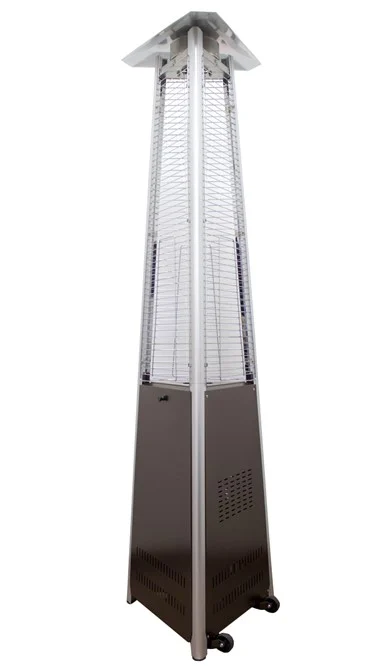
A glass-tube tower is the alternative for someone who wants the flame to be part of the patio’s appearance. The HLDS01-CGTHG is a 94-inch commercial-series triangular design with a quartz glass tube, tank access door, wheels, thermocouple and anti-tilt safety devices. Its manufacturer manual explicitly limits it to outdoor use.
The current Amazon listing states 40,000 BTU, while the manufacturer’s product page contains differing ratings of 41,000 and 42,000 BTU. The retailer’s title and selected color also conflict about the finish. These are reasons to confirm the exact shipped version, rather than silently choosing one number and presenting it as settled. Use the appliance rating plate for the final input and its supplied manual for installation requirements.
Choose it for the visible flame rather than as an assumed heating upgrade over a reflector model. A tall decorative flame does not establish greater useful warmth at chair level. The glass tube also adds a component that needs careful handling and a plan for replacement if damaged. Let the appliance cool fully before moving it or fitting a cover.
- Best for: a decorative outdoor focal point where a visible flame is the deciding feature.
- Main benefit: a glass-tube appearance that differs from a standard mushroom heater.
- Trade-off: glass, size and variant inconsistencies; not our first choice when straightforward seating-area warmth is the sole priority.
- Before buying: ask the seller to confirm the finish, rating, regulator and exact model revision.
How to choose a propane patio heater
Reflector heater or glass-tube tower?
A mushroom-style heater puts its burner below a broad reflector intended to direct radiant energy toward the surrounding seating area. A glass-tube tower adds a visible flame column and a different heat distribution. Start with your priority: warmth around a table, a decorative focal point, or flexibility to move the unit into storage. Neither design should be described as suitable for warming an indoor room.
For a sheltered outdoor area where a propane model cannot meet its manual’s clearance or ventilation requirements, an appropriately rated electric infrared installation may be more suitable. Electrical suitability, mounting distances and weather protection still need checking. Avoid choosing an indoor-only electric radiator for outdoor use.
Understand BTU ratings and coverage claims
BTU per hour describes the heater’s rated input. It does not directly tell you how warm every guest will feel. A 50,000 BTU heater has a higher listed input than a 46,000 BTU heater, but reflector geometry, wind and seating arrangement also matter. There is no universal BTU-to-patio-area conversion that guarantees comfort. Read our guide to British Thermal Units for the basic measurement.
On a large patio, one central heater may leave distant seats cold. Map your seating and walking routes before considering multiple heaters. Each appliance needs its own safe clearance and stable position. Moving a chair closer to the heater is only acceptable while keeping the required clearance from the person, cushions and furniture.
Check cylinder access, ballast and storage
A door or valve-access opening can be more useful in daily ownership than a small difference in advertised output. Check how the cylinder is secured, whether the regulator and hose are included, how the base is weighted, and whether the reflector will fit through the storage doorway. Move the heater only when it is off and cool, following the manufacturer’s cylinder-handling instructions. Wheels are for repositioning, not for rolling a lit heater between guests.
How much does a propane patio heater cost to run?
A useful estimate is cost per hour = cost to fill or exchange the cylinder ÷ usable running hours. As a purely illustrative example, a $25 fill lasting 8 hours costs about $3.13 per hour. That is not a current propane quote or a measured runtime for these heaters. Actual cost depends on local fill price, actual fuel quantity, output setting and the appliance’s fuel consumption. A nominal 20-pound cylinder may not contain 20 pounds of propane after an exchange.
Use the exact model’s consumption data for planning and budget for a spare cylinder if you entertain for long periods. Our propane tank-size guide explains the common cylinder choices. Do not substitute a different tank size, gas or regulator unless the heater manufacturer explicitly permits it.
Propane patio heater safety checklist
- Use outdoors only. Never operate these heaters in a home, garage, camper, tent or enclosed sunroom.
- Follow the exact manual for overhead and side clearances. Do not assume a pergola, canopy, umbrella or covered porch is acceptable.
- Stand on a level, stable surface and install the specified ballast. Stop operation in wind conditions prohibited by the manual or when stability or flame behavior is unsafe.
- Check hose condition and perform the manufacturer’s leak test after connecting a cylinder. Never check for leaks with a flame.
- Keep children, pets, fabrics and traffic routes away from hot surfaces. Tilt protection does not prevent contact burns.
- Turn the heater off, close the cylinder valve and let the appliance cool before handling the cylinder, moving the heater or fitting a cover. Store cylinders as directed by the supplier and local requirements.
Outdoor propane patio heater FAQs
Can you use a propane patio heater indoors or in a garage?
No. These are outdoor-only appliances that can produce carbon monoxide. An open garage door, fan or CO detector does not change the heater’s approval or make indoor use acceptable.
Can you put a patio heater under a covered patio or pergola?
Only if the exact manual permits that outdoor location and all ventilation and combustible-clearance requirements can be met. Measure above the reflector and to the sides. If the manual prohibits the setting or the required space is unavailable, choose another heating arrangement.
Is 50,000 BTU always better than 46,000 BTU?
It is a higher rated input, but not a guarantee of better comfort in every layout. Consider reflector design, seat distance, wind, clearance and control features. Do not compare advertising coverage figures as though they were measured under identical conditions.
How long will a 20-pound propane cylinder last?
It depends on its actual fill and the heater’s consumption at the chosen setting. Use model-specific consumption information and the amount of fuel actually supplied. Avoid assuming that every exchange cylinder is full to its nominal capacity.
Can a propane patio heater use butane or natural gas?
Do not substitute fuels based on a generic retailer description. Use only the gas, pressure, hose and regulator specified on your exact appliance and in its supplied manual. A propane heater is not automatically compatible with butane or natural gas.
Which is better: a pyramid heater or a mushroom heater?
A mushroom reflector is the starting point for a seating-area warmth comparison. A glass-tube pyramid is attractive when a visible flame is a priority. Neither shape guarantees a particular comfort radius, and both require outdoor use and proper clearances.
Sources and product checks
Checked 4 November 2026: EAST OAK cone-table heater specifications; AZ Patio Heaters glass-tube product page; Hiland glass-tube manual; Hiland CBT-series manual; current Amazon US manufacturer listings linked above; and CPSC outdoor-heater safety guidance. Conflicting variant information is flagged in the relevant sections. No fixed Amazon prices, invented performance tests or star ratings are used.